Moving to Hurghada in 2026: The Complete Expat Relocation Guide
Moving to Hurghada in 2026
The Complete Expat Relocation Guide
Everything you need to know about relocating to the Red Sea Riviera — costs, residency, neighbourhoods, schools, healthcare, and real estate.
Hurghada has transformed. Once a quiet fishing village on Egypt’s Red Sea coast, it is now one of the most compelling relocation destinations in the Mediterranean basin — offering European-standard living at a fraction of the cost, 360 days of sunshine a year, and a residency pathway tied directly to property investment. For discerning expats seeking a high-quality lifestyle without the punishing expenses of Dubai, the South of France, or the Greek islands, Hurghada in 2026 represents a rare alignment of value, climate, and opportunity.
This guide — prepared by MAMO Property, Hurghada’s premier real estate consultancy — covers every dimension of the relocation decision: cost of living, residency permits, neighbourhood selection, healthcare, education, the digital nomad experience, and the critical buy-versus-rent analysis. Whether you are a European retiree, a remote-working professional, or a family seeking a fresh start, this is your definitive roadmap to making Hurghada home in 2026.
1. Cost of Living — Red Sea Affordability
The headline figure is striking: the cost of living in Hurghada is approximately 60% lower than in Western Europe. This is not a compromise on quality — it is a structural advantage driven by favourable exchange rates, a competitive local market, and Egypt’s lower labour and service costs. A monthly lifestyle that would command €2,500–3,000 in Berlin or €3,500+ in London can be enjoyed here for €600–2,000, depending on household size and preferences.
Monthly Budget Overview
| Household Type | Monthly Budget (USD) | Monthly Budget (EUR) | vs. Western Europe Saving |
|---|---|---|---|
| Single Person | $600–800 | €550–730 | ~65% less |
| Couple | $900–1,200 | €820–1,100 | ~60% less |
| Family of Four | $1,400–2,000 | €1,280–1,830 | ~55% less |
Detailed Cost Breakdown
| Category | Monthly Cost (USD) | Notes |
|---|---|---|
| Rent — 1BR City Centre | $300–500 | Furnished or unfurnished options |
| Rent — 3BR City Centre | $600–900 | Spacious family apartments |
| Rent — Luxury Beachfront | $600–900 | Resort-style living, sea views |
| Rent — Villa | $1,500–3,000 | Private pool, garden, premium areas |
| Utilities | $40–70 | Higher in summer (AC usage) |
| Internet | $15–25 | Fibre broadband available |
| Mobile Plan | $5–20 | Generous data packages |
| Groceries (per person) | $100–150 | Local produce + imported options |
| Local Meal Out | $2–5 | Egyptian staples, street food |
| Mid-Range Restaurant (2-course) | $8–15 | International cuisine available |
| Coffee | $1.50–3 | Café culture is vibrant |
| Taxi Across City | $1.50–3 | Careem/Uber similar pricing |
| Microbus | $0.25–0.50 | Extensive local network |
What this data reveals is that a couple can live exceptionally well in Hurghada on less than $1,200 per month, including a comfortable apartment, dining out regularly, and maintaining a modern connected lifestyle. For context, that same budget in London or Paris would barely cover a shared room and groceries.
2. Residency via Property Investment
One of the most attractive features of relocating to Hurghada is Egypt’s property-linked residency programme. Unlike many countries where residency requires a complex points system or a massive capital outlay, Egypt offers a straightforward, renewable residency permit that is tied directly to real estate ownership. This makes buying a home in Hurghada not just a lifestyle decision but also an immigration strategy.
| Investment Threshold | Residency Duration | Renewable? | Path to Citizenship |
|---|---|---|---|
| $50,000+ | 1-year permit | Yes | After 10 years continuous residence, eligible to apply for Egyptian citizenship |
| $100,000+ | 3-year permit | Yes | |
| $200,000+ | 5-year permit | Yes |
For most expats, the sweet spot is the $100,000+ threshold, which grants a three-year renewable permit and avoids the annual renewal administrative cycle. The five-year option at $200,000+ is ideal for families seeking long-term stability. Crucially, after a decade of continuous residence, you become eligible to apply for Egyptian citizenship — a genuine path to permanent belonging in one of the world’s most historically rich nations.
The process is managed through Egypt’s Investment and Immigration authorities, and we strongly recommend working with an experienced local partner — such as MAMO Property — to navigate the documentation, property registration, and permit application smoothly.
3. Best Neighbourhoods for Expats
Hurghada stretches approximately 40 kilometres along the Red Sea coast, and within that corridor lies a remarkable diversity of neighbourhoods — each with its own character, price point, and expat community. Here is our expert assessment of the prime locations for international residents in 2026.
| Neighbourhood | Vibe & Lifestyle | Best For | Approx. Rent (1BR) |
|---|---|---|---|
| Sahl Hasheesh | Luxury resort corridor, gated compounds, pristine beaches | Affluent families, investors seeking capital appreciation | $500–900 |
| El Gouna | Lagoon city, world-class golf, marina lifestyle, vibrant expat scene | High-net-worth individuals, water sports enthusiasts | $600–1,200 |
| El Kawther | Walkable, excellent local services, established community | Budget-conscious expats, long-term residents | $300–500 |
| Al Ahyaa | Emerging area, new developments, more affordable | First-time buyers, investors seeking growth | $250–450 |
| Sheraton / El Hadaba | Central location, panoramic sea views, lively dining scene | Professionals, couples who want city energy | $350–600 |
| Intercontinental Area | Mid-market convenience, near hotels and amenities | Digital nomads, short-term renters | $350–550 |
| Mamsha | Modern beachfront promenade, contemporary apartments, trendy cafés | Young professionals, lifestyle-focused renters | $400–700 |
Sahl Hasheesh deserves special mention. This master-planned resort destination has become the premier address for luxury living on the Red Sea. Its gated communities — including developments such as CALA, Veranda, and Riva Beachfront — offer European-standard construction, landscaped gardens, private pools, and direct beach access. Properties here command premium pricing but also deliver the strongest capital appreciation in the region.
El Gouna, located roughly 25 kilometres north of Hurghada, is its own self-contained universe: a network of lagoons, islands, and private marinas connected by water taxis. With championship golf, a world-renowned kitesurfing scene, and a sophisticated dining and nightlife offering, El Gouna attracts a distinctly international crowd. It is more expensive than Hurghada proper, but for those who can afford it, it offers a lifestyle unmatched anywhere on the Egyptian coast.
For those who prefer to be in the heart of the city, Sheraton and El Hadaba offer dramatic clifftop views of the Red Sea, a dense concentration of restaurants and shops, and easy access to Hurghada’s international airport — a 10-minute drive. This area is particularly popular with European professionals and couples who want walkability without sacrificing sea views.
4. Buying vs. Renting — The 2026 Analysis
One of the most consequential decisions any expat faces is whether to buy or rent. In Hurghada, the arithmetic is unusually compelling for buyers, especially for those planning to stay beyond two years.
| Criterion | Renting | Buying |
|---|---|---|
| Upfront Cost | 1–3 months rent deposit | $50,000–500,000 for purchase |
| Monthly Outlay (1BR) | $300–500 (non-recoverable) | $0 (equity-building) + service fees ~$30–60 |
| Residency Benefit | None | 1–5 year renewable residency permit |
| Capital Appreciation | None | Strong — Hurghada market is rising |
| Rental Income Potential | N/A | 6–10% gross yield via holiday lets |
| Flexibility | High — easy to move | Lower — but resale market is active |
Purchase prices in Hurghada remain remarkably accessible by international standards. Apartments start from $50,000–80,000 for a quality unit in a good area, while luxury villas range from $150,000 to $500,000. To put that in perspective: $150,000 would barely cover a deposit on a studio apartment in central London or Manhattan. In Hurghada, it buys a villa with a private pool, sea views, and a residency permit.
For investors, the holiday rental market is a significant additional return driver. Hurghada’s tourism sector has rebounded strongly post-pandemic, and short-term rental yields of 6–10% gross annually are achievable in well-managed properties, particularly in the resort areas of Sahl Hasheesh and El Gouna. MAMO Property’s in-house management team can oversee the entire rental operation — from guest communications and cleaning to maintenance and revenue optimisation — allowing owners to earn passive income while enjoying their property for personal use during the year.
Our recommendation: If you plan to stay in Hurghada for two years or more, buying is the superior financial decision. The residency benefit alone can justify the investment, and the capital appreciation potential adds a wealth-building dimension that renting cannot match. For shorter stays — or for those who want to test the waters — renting initially (3–6 months) and then buying once you know the area intimately is a sensible hybrid approach.
5. Healthcare — Quality at Low Cost
Healthcare in Hurghada is both affordable and of a quality that comfortably meets international standards. The city is home to several well-equipped private hospitals and clinics, many staffed by doctors trained in Europe and the United States. English is widely spoken in the medical sector, and the costs are a fraction of what you would pay in Europe or North America.
- General doctor visit: $20–40
- Dental cleaning: $20–40
- International health insurance: $500–1,000 per year (comprehensive coverage)
Most expats opt for an international health insurance policy — typically €500–1,000 annually — which provides access to the best private hospitals in Hurghada and Cairo, plus coverage for medical evacuation if needed. For routine consultations and dental care, paying out-of-pocket is perfectly viable given the low costs. The availability of high-quality pharmacies with most common medications without prescription adds another layer of convenience for newcomers.
6. International Schools — Education for Expat Families
Families relocating to Hurghada will find a growing selection of educational options, from affordable local private schools to full international schools offering British, American, and German curricula.
- International schools: $2,000–8,000 per year — British, American, and IB curricula available
- Local private schools: $500–2,000 per year — Arabic curriculum with strong English programmes
Compared to international school fees in Dubai ($10,000–25,000/year) or Western Europe, Hurghada’s international schools offer exceptional value. Several institutions in the El Gouna and Sahl Hasheesh corridors cater specifically to the expat community, with small class sizes, modern facilities, and a genuinely multicultural student body. Many families find that the savings on education alone significantly offset the cost of relocation.
7. Digital Nomads — The Red Sea Remote-Work Hub
Hurghada has quietly emerged as one of the Mediterranean’s most attractive destinations for digital nomads and remote workers. The ingredients are all in place: reliable fibre internet ($15–25/month), an extensive café culture with strong WiFi, co-working spaces in El Gouna and downtown Hurghada, and a time zone (UTC+2/3) that overlaps comfortably with both European and Middle Eastern working hours.
What truly sets Hurghada apart, however, is the lifestyle-per-cost ratio. A digital nomad earning a Western salary can live here in considerable comfort — ocean-view apartment, daily café visits, regular diving or kitesurfing, excellent dining — for $800–1,200 per month. The same quality of life in Bali’s Canggu now costs $1,500+, while Lisbon or Barcelona would run $2,500+. Hurghada represents one of the few remaining great-value destinations that does not compromise on infrastructure or safety.
The Red Sea’s 360 days of sunshine per year mean that outdoor lifestyle is not seasonal — it is year-round. From November to March, when Europe is grey and cold, Hurghada delivers 22–26°C days, crystal-clear water, and empty beaches. This reverse-season appeal is a powerful draw for Northern Europeans in particular.
8. Lifestyle & The Red Sea Experience
Beyond the numbers, there is the life you actually live. Hurghada’s Red Sea coastline is recognised as one of the world’s premier diving destinations, with the Giftun Islands, Abu Ramada, and the SS Thistlegorm wreck within easy reach. The marine biodiversity — coral gardens, dolphins, sea turtles, and reef sharks — rivals the Great Barrier Reef, with water visibility often exceeding 30 metres.
For non-divers, the lifestyle offering is equally rich: world-class kitesurfing and windsurfing (particularly in El Gouna and Makadi Bay), deep-sea fishing, quad-biking in the Eastern Desert, golf at the El Gouna 18-hole championship course, and a dining scene that spans traditional Egyptian, Italian, Asian fusion, and fine French cuisine.
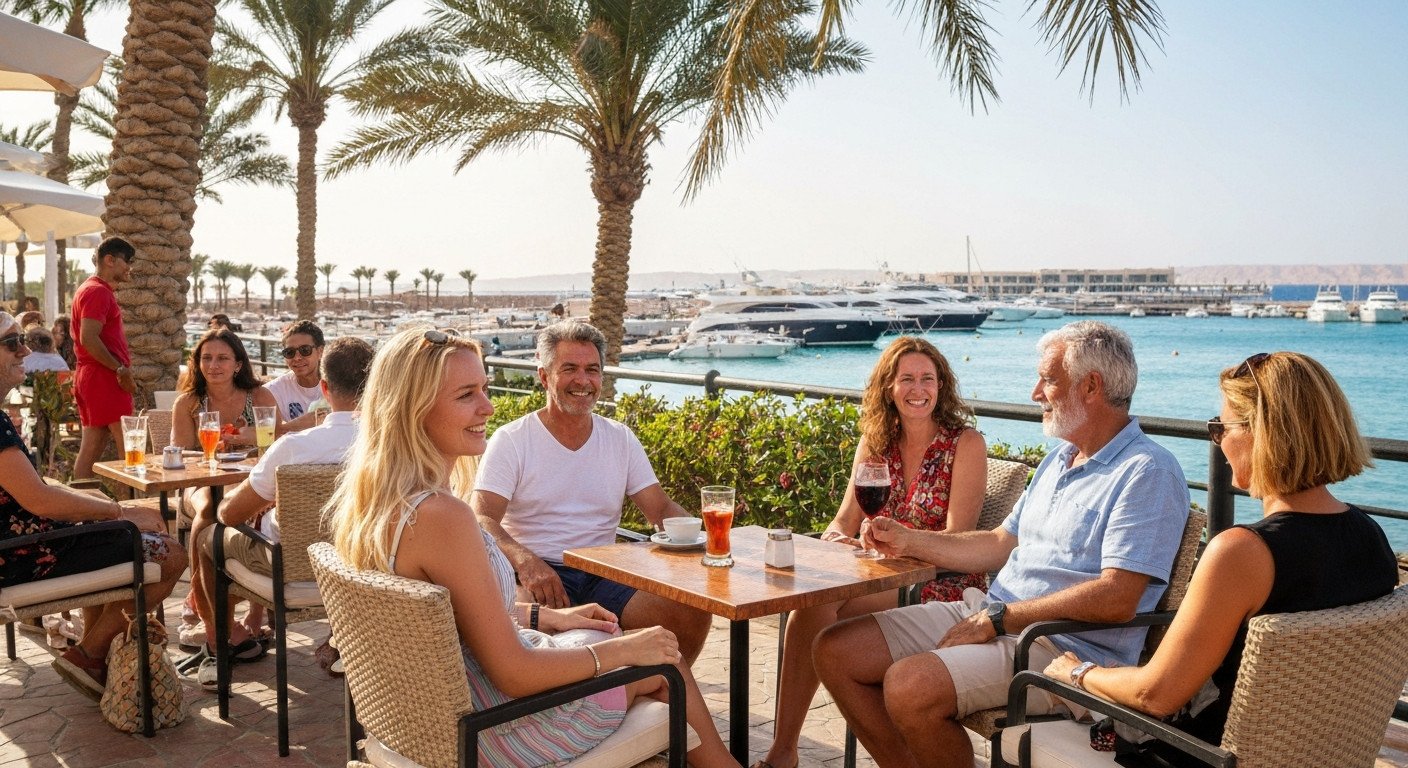
The expat community in Hurghada is welcoming and well-organised, with regular social events, charity fundraisers, and interest groups. The city’s population of approximately 250,000 is large enough to provide excellent amenities but small enough that you quickly become part of a community — a balance that many larger expat hubs struggle to achieve.
9. Frequently Asked Questions
Can foreigners buy property in Hurghada?
Yes. Egyptian law permits foreign nationals to purchase property in designated areas, including most of Hurghada, Sahl Hasheesh, and El Gouna. The process is straightforward and involves registration with the Egyptian Cadastre Authority. MAMO Property handles the full legal process for international buyers.
Is Hurghada safe?
Yes. Hurghada is one of the safest cities in Egypt and the broader Middle East. The tourist police presence is strong, violent crime is extremely rare, and the expat community reports a high sense of security both day and night. Standard urban precautions apply, but overall safety is considered excellent.
Do I need to speak Arabic?
Not for daily life. English is widely spoken in the tourism, real estate, medical, and hospitality sectors. However, learning some basic Arabic phrases is appreciated and enriches the experience. Many expats find that they function perfectly well with English alone while gradually picking up the language.
What is the process for opening a bank account?
Expats can open bank accounts in Egypt with their passport and residency permit. Most major Egyptian banks have English-speaking staff and offer online banking. Having a local account is essential for paying utility bills and receiving rental income if you become a landlord.
How do I get from Hurghada International Airport to the city?
Hurghada International Airport (HRG) is located approximately 5 km from the city centre and 15 km from Sahl Hasheesh. Taxis and ride-hailing apps (Uber/Careem) are readily available, with fares between $3–10 depending on your destination. The airport serves direct flights from most major European cities.
Ready to Make Hurghada Your Home?
Whether you are looking to buy, rent, or simply explore your options, MAMO Property is Hurghada’s trusted real estate partner for international clients. From property search and legal due diligence to residency applications and property management — we guide you through every step.
WhatsApp: wa.me/201152980998 · Web: mamoproperty.com
📚 Further Reading:
- our comprehensive Red Sea location comparison guide
- our complete El Gouna buyer’s guide
- our detailed Sahl Hasheesh area guide
- our Makadi Bay investment guide
- our rental yield comparison and ROI calculator
- our complete guide to foreign property ownership in Egypt
- our residency-by-investment guide
- our expat communities in Hurghada guide
- our Hurghada property appreciation trends analysis
- our complete buyer’s guide covering all fees and taxes
- our news coverage of Egypt’s 48-hour work permit
- our short-term vs long-term rental yield comparison
- Veranda Sahl Hasheesh project page
- CALA compound details
- our analysis of Egyptian Pound trends and foreign reserves
- our Egypt tourism 2026 impact analysis
Frequently Asked Questions
Q: How should I prepare if I am planning on moving to Hurghada 2026?
A: You should start by consulting a detailed Hurghada expat relocation guide to familiarize yourself with local laws and lifestyle. Additionally, plan the logistics of moving to Hurghada well in advance and research top-rated options for Hurghada real estate for expats to secure your ideal home before arriving.
Russian-Speaking Expats in Hurghada
For Russian-speaking clients planning their move to Hurghada, we provide dedicated support in Russian — from property selection to residency documentation. Visit mamoproperty.ru for comprehensive guides and expert consultation in your language.
Co-founder of MAMO Property, real estate specialist in Hurghada with 16+ years experience in Egyptian property market.