
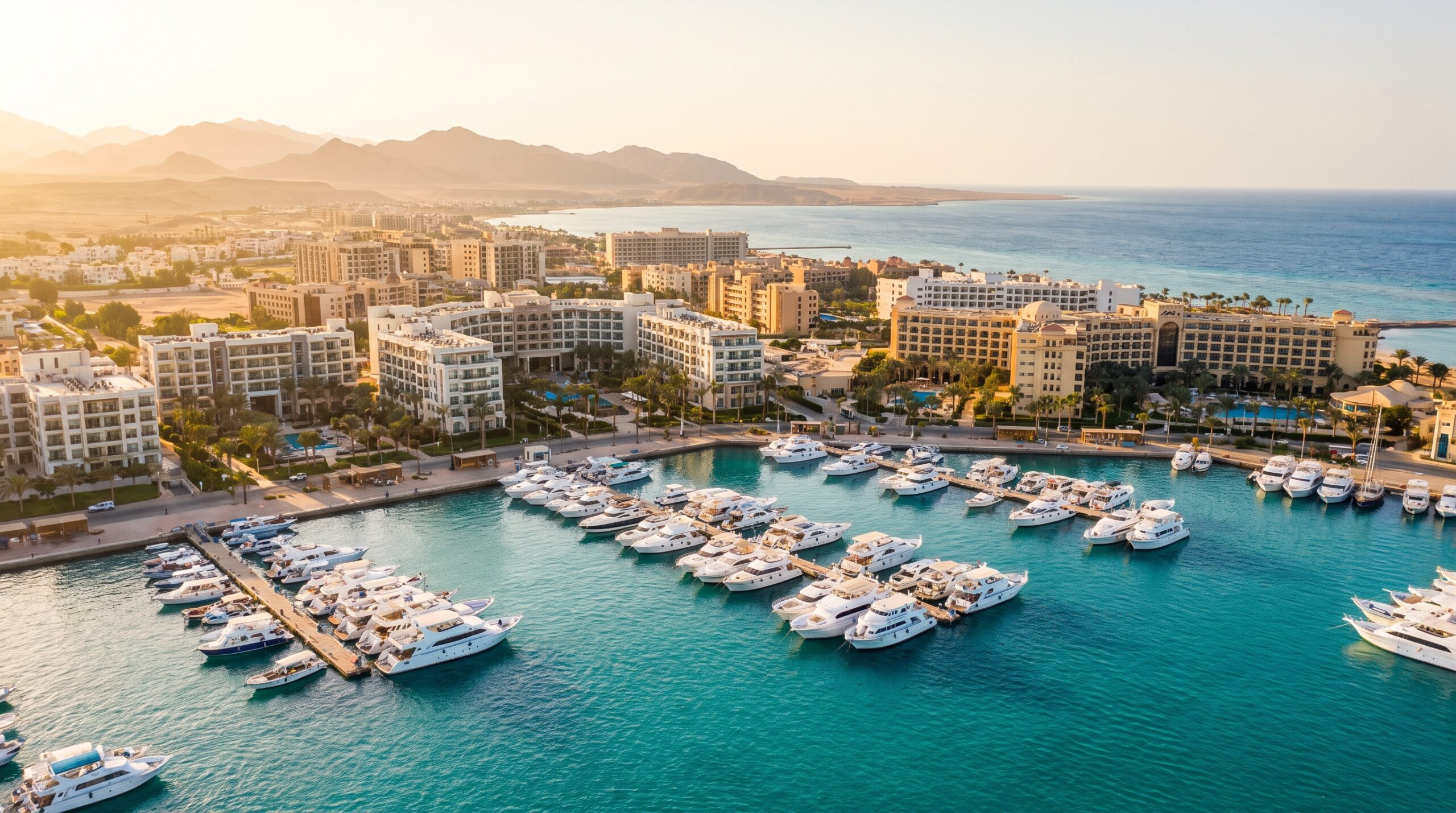
Hurghada Long-Term Rental Market 2026: The Investor’s Complete Guide
If you’ve spent any time browsing international real estate in 2026, you’ve seen the same pitch: “guaranteed 10% rental yields,” “passive income by the sea,” “your ticket to financial freedom.” Most of it is noise.
What follows is the actual data: a verified, source-by-source look at Hurghada’s long-term rental market in 2026 — what it costs, who rents, what the law changed in August 2025, and where a foreign investor can realistically make 8–12% net per year. Every claim is sourced. Every number is cross-checked.
MAMO has been operating on the Red Sea since 2008. We’ve watched this market through two currency crises, one pandemic, and the largest rental-law reform in Egypt’s modern history. The long-term rental segment is, in our view, the single most overlooked investment angle in Hurghada right now. Here’s the case — and the honest risks.
Why Hurghada, why now
Hurghada is a year-round resort city of roughly 250,000 residents that receives over 9 million visitors annually. The Red Sea coast delivers 340+ days of sunshine, winter averages of 22–25°C, and — unlike Spain, Greece, or Turkey — no real off-season. A well-managed apartment in Hurghada can achieve 200–250 days of meaningful rental activity per year. A comparable property in Marbella or the Algarve is at 50–60.
Three structural forces have made the long-term segment — typically 6-to-12-month leases — both larger and stickier over the last three years:
- Digital nomad boom. Egypt’s nationwide internet upgrade averages 80 Mbps (the fastest in Africa). A $600 million FTTH joint venture is rolling out deeper coverage across the Red Sea governorate. Coworking capacity in Hurghada has grown from 40 seats in 2023 to over 220 today. The government now offers a 5-year multiple-entry visa for freelancers.
- Internal Egyptian migration. Remote and hybrid work has made it possible to keep a Cairo job while living by the sea. Internal migrants now sign 12-month+ contracts in El Ahyaa, Mubarak, and El Kawther — a stable, structural demand pool that doesn’t disappear with tourism cycles.
- European expat demand. Direct EU flight routes into Hurghada International grew from 17 in 2023 to 27 in 2025 — new links from Berlin, Warsaw, and Madrid reduce travel time to under 5 hours. Russian-speaking, German, Polish, Czech, and Italian buyers and renters form the core of the long-let segment.
What does a long-term rental actually cost in Hurghada in 2026?
Same district can show a 2–3x spread between listings because of (a) furnished vs unfurnished, (b) sea view vs inland, (c) compound vs standalone, and (d) whether rent is published in or hard currency. The table below is built from 8+ cross-checked listing portals (Property Finder, Bayut, FazWaz, Numbeo, FlatSwipe, CityCost, Wise) and our own internal data. All figures are monthly, long-term, USD, at the April 2026 rate of ~50 per 1 USD.
| District | Studio | 1-Bedroom | 2-Bedroom | 3-Bedroom |
|---|---|---|---|---|
| El Dahar (downtown) | $150–250 | $200–300 | $300–450 | $400–600 |
| El Ahyaa | $170–300 | $220–400 | $300–500 | $450–650 |
| El Kawther (expat default) | $200–350 | $280–450 | $450–700 | $600–900 |
| Sakkala / Sheraton Road | $250–400 | $350–500 | $500–800 | $700–1,000 |
| El Mamsha (seafront) | $300–500 | $400–650 | $500–800 | $800–1,200 |
| Magawish | — | $300–500 | $500–700 | $700–1,000 |
| Sahl Hasheesh (resort) | $400–700 | $700–1,500 | $1,200–2,500 | $1,500–3,000 |
| Makadi Heights / Bay | — | $400–600 | $500–800 | — |
| El Gouna (separate town) | — | $700–1,200 | $1,000–2,000 | $1,500–3,000+ |
The citywide median monthly rent for a long-term apartment in Hurghada sits at ~EGP 18,000 (~$360). Numbeo’s index for a 1-bedroom in the city center averages 11,172 (~$223); outside the center, 6,092 (~$122). For context: a 1-bedroom in central Hurghada costs roughly 30–50% less than the same standard in Cairo’s Maadi or Zamalek districts, which run $1,500–$2,500/month.
The furnished premium: 20–30% above unfurnished
For a property investor, this is the single most important lever you control. A furnished apartment rents for 20–30% more per month than the same apartment empty — and in some premium areas the premium runs higher. The trade-off:
- Furnishing cost in Egypt: expect $3,000–$5,000 (EGP 140,000–235,000) for a complete basic-to-mid-range fit-out (beds, sofa, fridge, washing machine, cooker, AC units, basics).
- Payback on the rent premium: at a 25% premium on a 1-bedroom in El Kawther ($280 unfurnished → $350 furnished), the extra $70/month recoups a $4,000 fit-out in about 57 months. Over 5 years, you’ve earned $700 net on the rent premium after deducting furnishing cost.
- For shorter stays (<2 years): furnished wins — your tenant avoids the $3,000–$5,000 upfront outlay, and you’ll re-rent faster.
- For longer stays (>2 years): unfurnished wins — lower monthly rent, the tenant’s furniture is theirs to keep, and you avoid the depreciation hit on yours.
For the long-let segment specifically, we recommend furnished for almost every buyer. The market is structurally tenant-friendly to “move in with a suitcase” offerings, and your time-to-let drops by 30–40%.
The legal framework after the August 2025 reform
On 5 August 2025, Egypt ratified two new rental laws that fundamentally reshaped the market. This matters to every property investor because it changes who can evict, when, and how fast.
- Law 164 of 2025 ends the pre-1996 “old rent” regime, where rents were frozen for decades and inherited by tenants’ children. Old residential contracts now terminate automatically on 5 August 2032 (7 years from enforcement). Interim rent is 250/month until zonal classification completes; then 20x current legal rent in premium zones (min 1,000), 10x in middle and economic zones (min 400 and 250 respectively), plus 15% annual increase.
- Law 165 of 2025 is what affects you. It amended the Civil Code framework that governs every lease signed after 30 January 1996 — which is almost all of Hurghada. It added Article 2-bis: tenants must vacate at end of term, and if they refuse, the landlord can petition the Judge of Interim Matters for an immediate eviction order. Filing a substantive lawsuit by the tenant does not suspend the eviction.
The practical effect: in 2026, a long-let landlord in Hurghada has the strongest eviction rights in the modern Egyptian era, provided the contract is registered at the Shar Al-Akari (Notary Public). This converts the lease into an “execution deed” and unlocks the fast-track eviction. A typical 12-month contract costs ~$50 to authenticate. Skipping it is a real exposure we see investors make.
Yields: the actual numbers, gross and net
Where this gets interesting for an investor. Per Global Property Guide’s Q2 2025 data, Hurghada’s city-average gross rental yield is 7.29%, with a range of 5.86% to 8.08% across districts. The national Egyptian average is 6.77%. For comparison, prime European coastal markets (Spain’s Costa del Sol, Portugal’s Algarve) deliver 4–6% gross.
Split by strategy:
| Strategy | Gross yield (city average) | Net yield (after 8–12% mgmt + 5% maintenance + 15% vacancy buffer) |
|---|---|---|
| Long-let (12-month lease) | 5–10% | 3.5–7% |
| Mid-term (1–6 month, nomads) | 8–10% | 5.5–7% |
| Short-let (Airbnb/Booking) | 10–18% | 5–10% |
The short-let yield looks attractive on paper, but the workload is 3–4x higher (dynamic pricing, multi-platform listing, cleaning logistics, guest communication, 30+ hours per month of attention) and the management fee is 15–25% of revenue vs 8–12% for long-let. The honest comparison is net yield — and on that basis, the gap shrinks considerably.
For a remote foreign owner who can’t self-manage, the long-let strategy wins on risk-adjusted return. You give up some yield for: (a) one tenant, one handover, (b) 8–12% flat management fee, (c) predictable monthly cash flow, (d) near-zero vacancy in well-located stock. The most active segment in 2026 is actually mid-term furnished lets to digital nomads (3–6 months) — this captures some of the short-let yield premium with materially less work.
The honest risks
No market is risk-free. Here are the four risks that matter for an investor in Hurghada’s long-let segment, ranked by severity.
1. /USD currency mismatch
This is the single biggest risk for a foreign owner who takes rent in and lives in hard currency. The Egyptian pound has lost ~82% of its value against the USD since the November 2016 float, with another 38% devaluation in early 2024. Worked example: a £45,000 property purchased at 65 /£1 with annual rent of 3,250,000 (about £50,000 at the time). If weakens to 80 /£1, your rental income in GBP drops to £40,625 — a 19% income reduction. If it strengthens to 50, you gain 30%.
Mitigation: accept USD or EUR for rent where you can (most expat-facing landlords do), convert monthly via Wise rather than a high street bank (saves 3–5% per conversion), and don’t let accumulate. Don’t try to time the rate — convert on a fixed schedule.
2. Tourism downturn
Hurghada is exposed to geopolitical shocks in the broader Middle East. During 2020–2021 the city saw an 80%+ drop in arrivals. Long-let demand is a partial natural hedge — expats and internal migrants don’t disappear during tourism downturns — but resale liquidity can dry up.
3. STR supply overshoot
Airbtics reports Hurghada added +940 new STR listings in 2025 (+39.7% supply growth). Per AirDNA, median occupancy has dropped from 65–85% in 2022 to ~36% in 2025. Top decile still achieves 81%+; the bottom half is suffering. This is a short-let-specific risk — long-let occupancy is structurally higher and more stable.
4. Old rental law litigation
Low probability but real: even post-reform, disputes with old tenants or inheritors of pre-1996 contracts can drag into Egyptian courts for 12–24 months. Authenticate your contract at the Notary Public at signing. It costs ~$50 and gives you the fast-track eviction path. Skipping it is the most common avoidable mistake we see.
What a realistic 2026 investment looks like
Putting it together for a foreign buyer working in hard currency:
- Entry price (1-bedroom, El Ahyaa or El Kawther): $30,000–$50,000 fully furnished
- Annual long-let rent: $3,600–$5,400 (12 × $300–$450/month)
- Gross yield: 8–12%
- Net yield (after 10% management + 5% maintenance + vacancy buffer): 5–7%
- Capital appreciation (5-year average): 8–15% annually in prime, 12–18% in emerging
- 5-year total return (yield + appreciation): 12–20% annually, depending on district
That’s a risk-adjusted return profile that compares favorably with most European coastal markets, at half (or less) of the entry price. The catch is that you need a local partner who handles tenant sourcing, contract registration, and rent collection in a market where you can’t physically be present.
Frequently asked questions
Is it legal for a foreigner to buy property in Hurghada?
Yes. Egypt allows foreign freehold ownership of residential property. The process takes 2–6 weeks and includes a title check, translation, Notary authentication, and registration with the Real Estate Public Registry. A qualified Egyptian lawyer handles this for ~$1,000–$1,500. There is no residency requirement tied to ownership, though buying property does make obtaining a multi-entry residence permit easier.
What’s the difference between long-term and short-term rental in Hurghada?
Long-term is a 6-to-12-month residential lease, typically unfurnished or fully furnished, paid monthly or quarterly, governed by Egyptian Civil Code. Short-term is nightly or weekly holiday lets, typically on Airbnb or Booking, fully furnished, governed by hospitality platform terms. The long-term segment is what we recommend for most foreign investors; short-term is operationally intensive and only works in specific micro-markets.
What return can I realistically expect on a Hurghada rental property in 2026?
For long-let residential: 5–10% gross, 3.5–7% net after costs. For short-let: 10–18% gross, 5–10% net. For mid-term furnished lets (1–6 months, often to digital nomads): 8–10% gross, 5.5–7% net. Plus capital appreciation of 8–15% annually in prime areas. Total return over 5 years typically 60–120% cumulative, depending on entry timing and district.
Do I need a property management company if I live abroad?
Strongly recommended. Local property management for long-let in Hurghada costs 8–12% of monthly rent and includes tenant sourcing, contract drafting and registration, monthly inspections, rent collection, and tenant handover. Going without a manager is possible but typically results in 1–2 months of additional vacancy per year, which wipes out the management fee several times over.
How does the August 2025 rental law reform affect me as a foreign landlord?
If your Hurghada property is leased under a post-January-1996 contract (almost all of them), the reform gives you the strongest eviction rights in modern Egyptian history, provided you authenticate the contract at the Notary Public. Tenants must vacate at end of term; if they refuse, the Judge of Interim Matters can issue an immediate eviction order. Rent is freely negotiated under the Civil Code — no statutory cap. The reform is genuinely pro-landlord for new contracts.
How MAMO can help
MAMO Property has been on the Red Sea since 2008. We work with foreign buyers, expat residents, and institutional investors across Hurghada, El Gouna, Sahl Hasheesh, and Soma Bay. Our services cover the full investor journey:
- Property sourcing — short-list of 5–10 candidate properties that match your budget, yield target, and risk profile
- Due diligence — title check, developer track record, completion certificate, contract review
- Purchase support — lawyer coordination, currency transfer, Notary registration, handover
- Long-term property management — tenant sourcing, contract registration, monthly rent collection, annual inspection, maintenance coordination. Our 8–12% fee is full-service, no hidden extras.
- Resale support — when the time comes, we handle the listing, buyer qualification, and transfer
Talk to us. WhatsApp is the fastest channel — we typically reply within an hour during Cairo business hours.
Or reach us on Telegram at @MAMOPropertyBot (bot for instant property alerts) or @mamo_property (channel for market updates). For longer questions, email info@mamoproperty.com — we respond within one business day.
This post is part of MAMO’s 2026 Hurghada Real Estate Market Series, drawing on data from the Egyptian General Property Guide, Global Property Guide, AirDNA, Airbtics, Numbeo, World Trips Hurghada, FlatSwipe, Kayan Development, Hurghada Homes, and the Hurghada Property German Buyers Guide. Last verified: August 2026.
Co-founder of MAMO Property, real estate specialist in Hurghada with 16+ years experience in Egyptian property market.