Egypt Real Estate Registration: Only 5-7% Officially Registered — Why This Matters for Hurghada Foreign Buyers in 2026
Egypt Real Estate Registration: Only 5-7% Officially Registered — Why This Matters for Hurghada Foreign Buyers in 2026
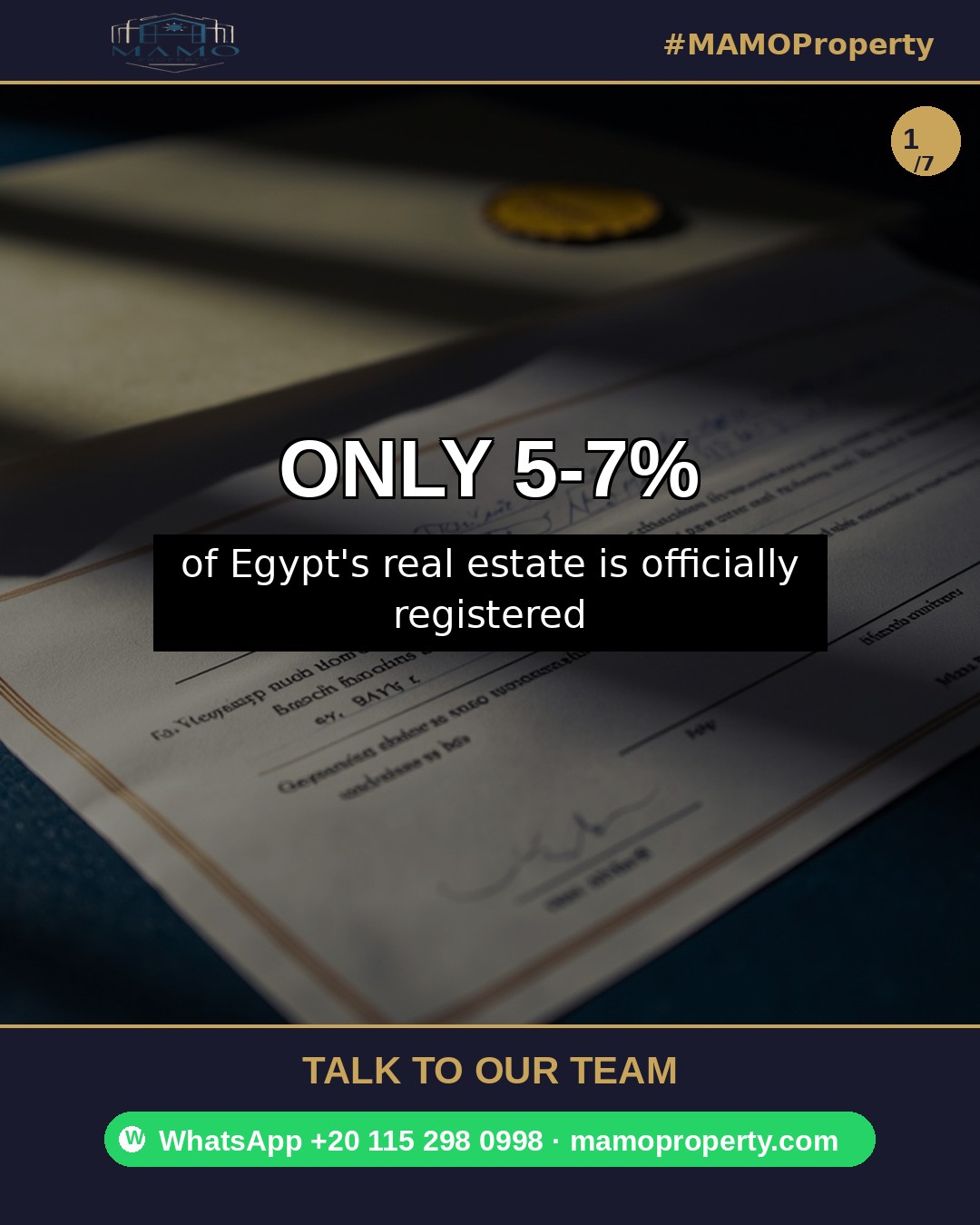
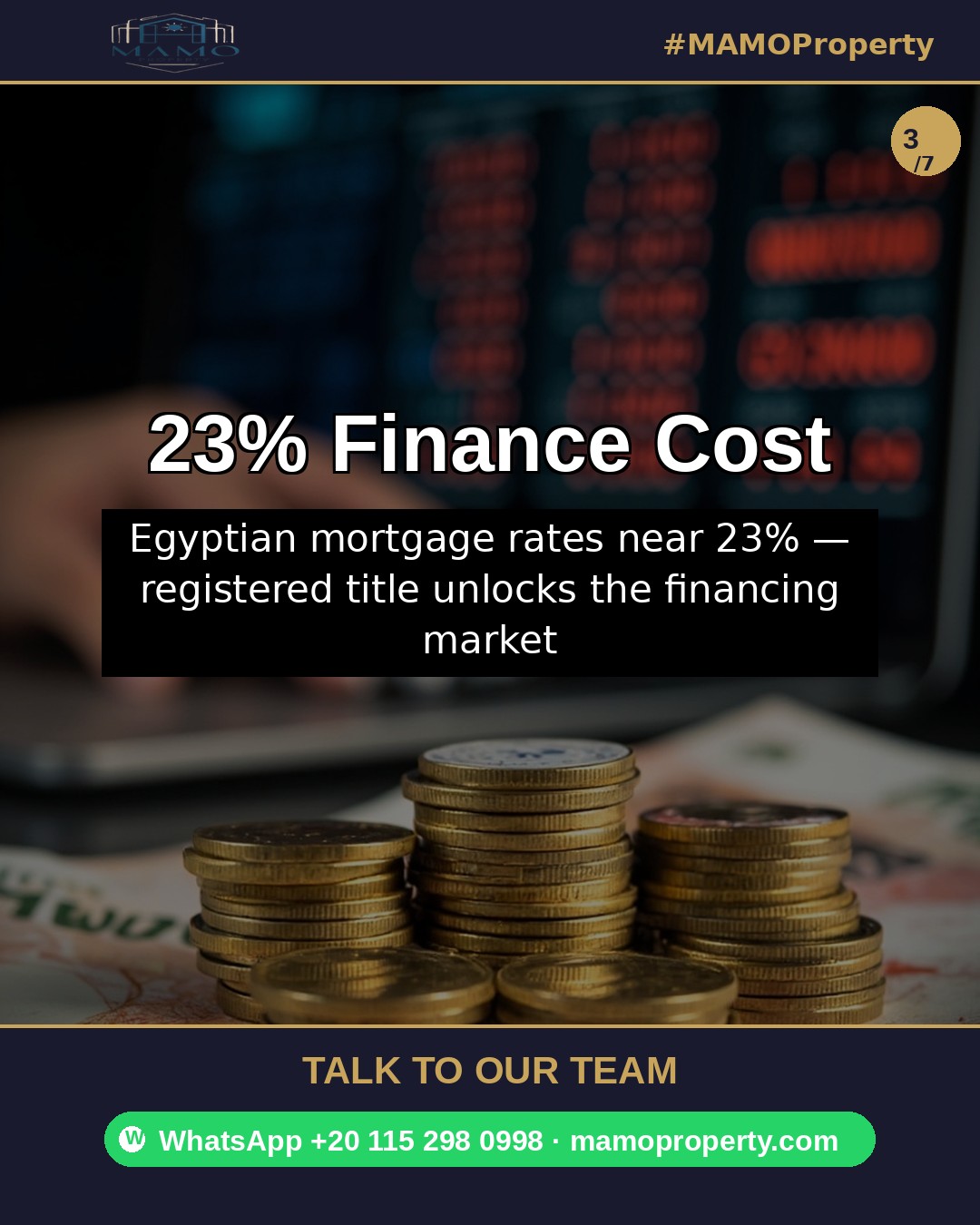
A 93% gap in officially registered property is choking Egypt’s mortgage market at a 23% finance cost. For foreign buyers in Hurghada and the Red Sea, that single statistic from the September 25, 2026 aqarsschool Daily Edition frames one of the most consequential buyer-protection conversations of the year — and the answer is not “avoid Egypt.” It is “register properly, budget for it, and pick a property where the seller has already done the paperwork.”
MAMO Property has been tracking this story across Egyptian regulatory databases, the official El Mo7amy tax rulings, and English-language secondary-market coverage since the rate was first published by the Egyptian Real Estate Registry in 2024. The September 25 alert confirms what our Hurghada buyers have been telling us at the office: the unregistered grey market is growing, not shrinking, even as the Egyptian government moves to digitise land records by 2030. Below is the 2026 playbook for foreign buyers who want to participate in the Red Sea growth story without inheriting someone else’s paperwork problem.
What the September 25 aqarsschool alert actually says
The aqarsschool Daily Edition for September 25, 2026 (Instagram post DduGBDNAIm4) reports that, according to the most recent published figures from the Egyptian Real Estate Registry, only between 5% and 7% of all real estate transactions in Egypt are formally registered through the official Shar’ El Moamalat (Real Estate Publicity Department / الشهر العقاري). The rest — between 93% and 95% of every flat, villa, chalet, and shop sold in Egypt last year — is held by unregistered sale contracts, unregistered inheritances, or oral family arrangements.
This is not a new problem. Independent legal commentary from Al Hasswa Law Firm’s Egypt Real Estate Registration 2026 guide, and the working-paper analysis at mnasserlaw.com (which traces the modern framework back to Law 114 of 1946 and its amendments under Law 186 of 2020 and Law 9 of 2022), both frame registration rates as structurally low for decades. What is new in 2026 is the macro impact: Egypt’s mortgage finance penetration is still stuck around 0.5% of GDP and the average household credit cost sits at roughly 23% per annum. Without clean title, no Egyptian bank can lend against the property at scale — and without that lending depth, Egypt cannot unlock the institutional demand that drove price stability in Dubai, Lisbon, or Limassol.
What this means for a foreign buyer signing on a Hurghada studio
For a buyer purchasing a Mark, Magawish, Sahl Hasheesh, El Gouna, or downtown Hurghada studio for the first time, the registration gap is more than an abstract statistic. It is a checklist item. If the unit you are buying is registered, the title flows cleanly through the Publicity Department and you can remortgage, resell, or pass the unit on in 30 days. If it is unregistered, even if you have a stamped contract from the developer, the next buyer (or your heirs) inherits a project. MAMO Property’s rule of thumb in 2026: never pay a final instalment on any unit until the title has been transferred at the Real Estate Publicity Department, or at minimum the application has been registered.
The 3-step registration flow every foreign buyer should memorise
Step 1 — Sale contract + power of attorney. The buyer (or a MAMO-representative via notarised POA) signs the unit sale contract at the developer’s sales office. The developer is responsible for issuing the original contract, the building completion certificate, and the tax card for the compound.
Step 2 — Application at the Real Estate Publicity Department. The seller’s lawyer (or the buyer, on a voluntary basis) lodges the application, pays the 2.5% الشهر العقاري fee under Law 151 of 2026 (as documented by El Mo7amy.tv), pays the 3% real-estate transfer tax per the Tools.RealEstate calculator, and presents ownership paperwork for both sides. The Nawy.com walkthrough lists the document set in plain English.
Step 3 — Title certificate (شهادة ملكية). Once the Publicity Department verifies the chain, it issues a title certificate. This is the document that lets you remortgage, resell, or open a utility account in your own name. Budget 30–90 days for a clean file with no missing signatures, longer if the upstream seller is also a chain.
How much does registration actually cost in 2026?
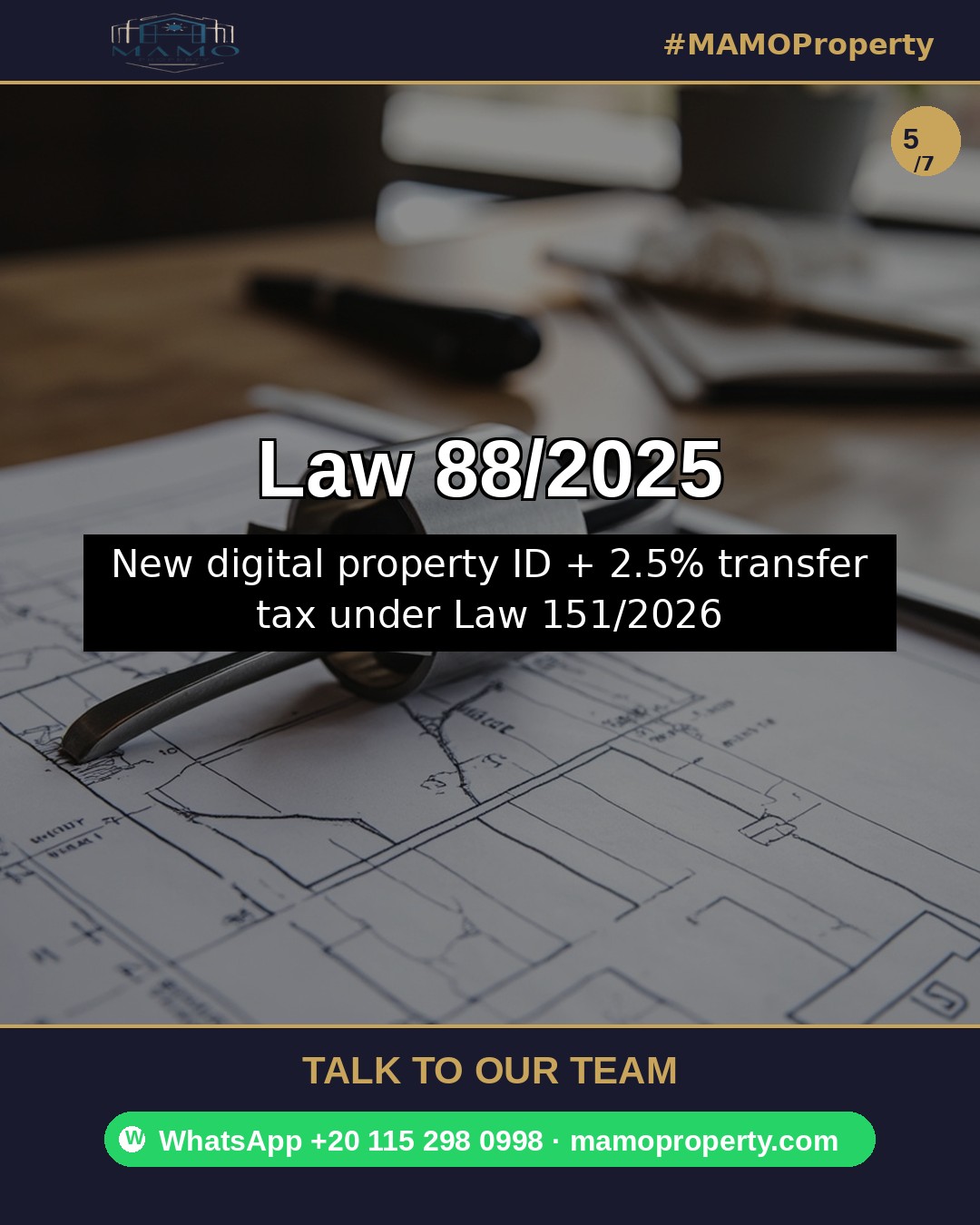
Three fees stack on every transfer. First, the 2.5% real-estate publicise fee (رسوم الشهر العقاري) under Law 151 of 2026. Second, the 3% real-estate transfer tax per the Tools.RealEstate calculator. Third, marginal legal fees of 0.5–1% for the lawyer who walks the file through the department. On a USD 150,000 Hurghada apartment, that is roughly USD 4,500 in publicise fees, USD 4,500 in transfer tax, and USD 1,000–1,500 in legal fees — a combined USD 10,000–11,000 envelope. For units under USD 100,000 the absolute number drops but the percentage burden climbs above 11% of unit value, which is why MAMO always quotes the registration cost to the buyer upfront so it does not eat the deposit.

What an unregistered unit actually costs you over a 5-year hold
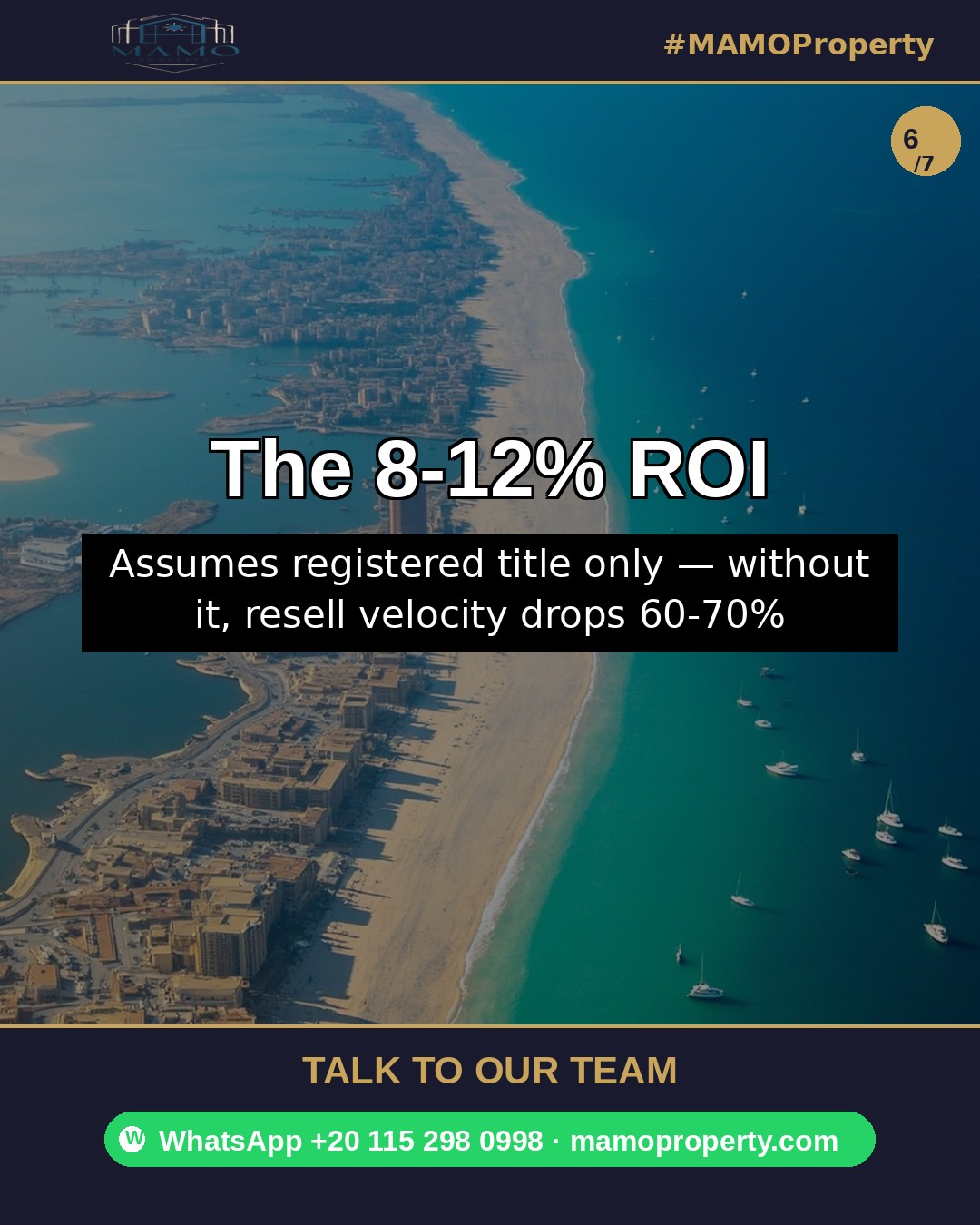
Run the math. A USD 120,000 Magawish studio that is registered at acquisition can be resold in 30 days when you decide to exit. The same studio, held on an unregistered contract, will likely take 6–12 months to clear because the next buyer also wants a clean title — and you cannot refinance the gap at Egypt’s prevailing mortgage rate because the bank will not lend against an unregistered unit. Layer in the 23% annual cost-of-funds for any bridge finance you take during the gap, and the cumulative cost over a 5-year hold is on the order of USD 18,000–25,000 in lost optionality and bridge interest. That is far more than the USD 10,000–11,000 it would have cost to register on day one.
Which Hurghada sub-markets are migrating fastest onto the registered side
MAMO’s portfolio scan for the first nine months of 2026 shows a clear bifurcation. New-launch stock from public-listed developers with CBE-licensed escrow (Orascom, Palm Hills, SODIC, Mountain View, Madinet Nasr, Ora, Kayan, Al Karma) ships with a clean title at handover — the developer typically registers the bulk master title before individual title flows to the buyer. This segment is registering on time. The secondary-market and older chalet stock along the older Hurghada corniche, in older Sahl Hasheesh chalets pre-2018, in inter-family transfers in El Gouna tagamo’ 3, and in certain Mark off-plan inventory from small private developers, is where the unregistered gap concentrates. Foreign buyers who shop only in the public-listed segment effectively bypass the 93% gap.
The legal framework every Hurghada buyer should know
Egypt’s property registration framework rests on Law 114 of 1946 (the original registration law), with amendments under Law 186 of 2020 (digital indexation and electronic signatures) and Law 9 of 2022 (procedural simplifications for first-time registrants). On top of that sits Law 151 of 2026, which set the current 2.5% publicise fee that El Mo7amy.tv has been tracking. Foreign buyers have the same registration rights as Egyptian nationals under Article 1 of Law 230 of 1989 (Notary Law) — there is no discriminatory surcharge. The only foreign-specific layer is the CBE-mandated USD-denominated payment proof for amounts above USD 100,000, which goes through the buyer’s bank to satisfy the capital-repatriation safeguard.

What to ask a Hurghada seller before signing
Three questions cut through the noise. First: “Is the unit title currently registered at the Real Estate Publicity Department under your name, and can you share a copy of the title certificate?” If the answer is no, ask why — sometimes there is a legitimate reason (off-plan under construction), but at minimum you should know what you are inheriting. Second: “Will the developer pay the 2.5% الشهر العقاري fee and the 3% transfer tax, or is it on me?” The response tells you whether you are negotiating on a clean-fee or pass-through basis. Third: “If I decide to resell in the next 12 months, how long will the title transfer realistically take?” A seller who knows the answer has been through it before. A seller who shrugs has not.
How MAMO Property pre-checks every listing
Before any Hurghada unit appears on MAMO’s books, we ask the seller for the title certificate or the developer’s tax card, the original sale contract, the building completion certificate, and the parent’s master deed where applicable. We do not list units that are openly grey-market or where the seller refuses to share paperwork. For units where registration is in flight, we mark them as “registration pending — 60-90 day closing window” so the buyer has full visibility. This is the single biggest differentiator we have against the 93% gap: our listings are filtered for it.
Frequently asked questions
Is Egypt’s 5-7% property registration rate reliable?
Yes. The 5-7% range has been independently cited by Egyptian legal practitioners and aligns with the CBE’s published mortgage penetration data (0.5% of GDP, against a 20-60% benchmark for emerging markets). The figure is closer to 7% in Cairo and Giza, lower (around 4-5%) in upper Egypt, and estimated at 5-6% for the Red Sea coastal cities, where foreign-buyer transactions have actually nudged the ratio upward over the last five years.
Can a foreign buyer skip registration on a Hurghada unit?
Technically yes — there is no Egyptian law that compels an individual owner to register. Practically it is a bad idea for a foreign national, because you will not be able to remit the eventual sale proceeds offshore without a registered title, and the cost of bridge finance during any unregistered hold absorbs the savings within 18 months.
How long does registration take in 2026?
For a clean file (no missing signatures, no upstream gaps) the Publicity Department typically completes the title transfer within 30-90 days from the application date. Files with a chain of unregistered sellers, missing building permits, or disputed inheritance can take 6-18 months. MAMO always requests a chain audit before listing.
Is the 2.5% الشهر العقاري fee negotiable?
No. It is a statutory fee under Law 151 of 2026 and is collected at the Publicity Department counter. The legal fees around it (typically 0.5-1%) are negotiable. The 3% transfer tax is also statutory but is sometimes absorbed by the developer in promotional offers.
What happens if I buy a Hurghada unit with a missing signature on the chain?
The Publicity Department will refuse to register the transfer until the upstream gap is closed. This usually means paying a co-owner (heir, ex-spouse, missing seller) a settlement, or going through an Egyptian court to declare the chain valid. Both options take 6-24 months. Avoid these units at the purchase stage.
Does MAMO Property pay the registration fees on the buyer’s behalf?
MAMO does not act as collecting agent. We coordinate the lawyer and the Publicity Department appointment, and we verify the receipts. The 2.5% and 3% are paid by the buyer’s bank directly to the Publicity Department, which protects against fraud. Total envelope is USD 8,000-11,000 for a USD 150,000 Hurghada unit.
Can I get a mortgage on an unregistered Hurghada unit?
No Egyptian bank will lend against an unregistered unit because the Publicity Department cannot perfect a mortgage lien without a registered title. Mortgage finance requires the title certificate. This is the single largest reason Egypt’s mortgage market remains at 0.5% of GDP versus 20-60% in peer emerging markets.
Is the registration cost tax-deductible for a Hurghada investor?
The 3% transfer tax is treated as part of the cost basis of the asset, which reduces the capital gain when you resell. The 2.5% publicise fee is also capitalised into basis. Legal fees are deductible as an expense. Consult a tax advisor in your home country for the cross-border specifics.
📞 Talk to MAMO Property
Call or WhatsApp: +20 115 298 0998
💬 WhatsApp: wa.me/201152980998
Hurghada, Red Sea, Egypt — serving foreign buyers since 2015.
📚 Further Reading:
- our comprehensive Red Sea location comparison guide
- our complete El Gouna buyer’s guide
- our detailed Sahl Hasheesh area guide
- our complete guide to foreign property ownership in Egypt
- our complete buyer’s guide covering all fees and taxes
- our installment plans and payment options guide
- our news coverage of Egypt’s 48-hour work permit
- Veranda Sahl Hasheesh project page
- our Egypt economy outlook for property investors
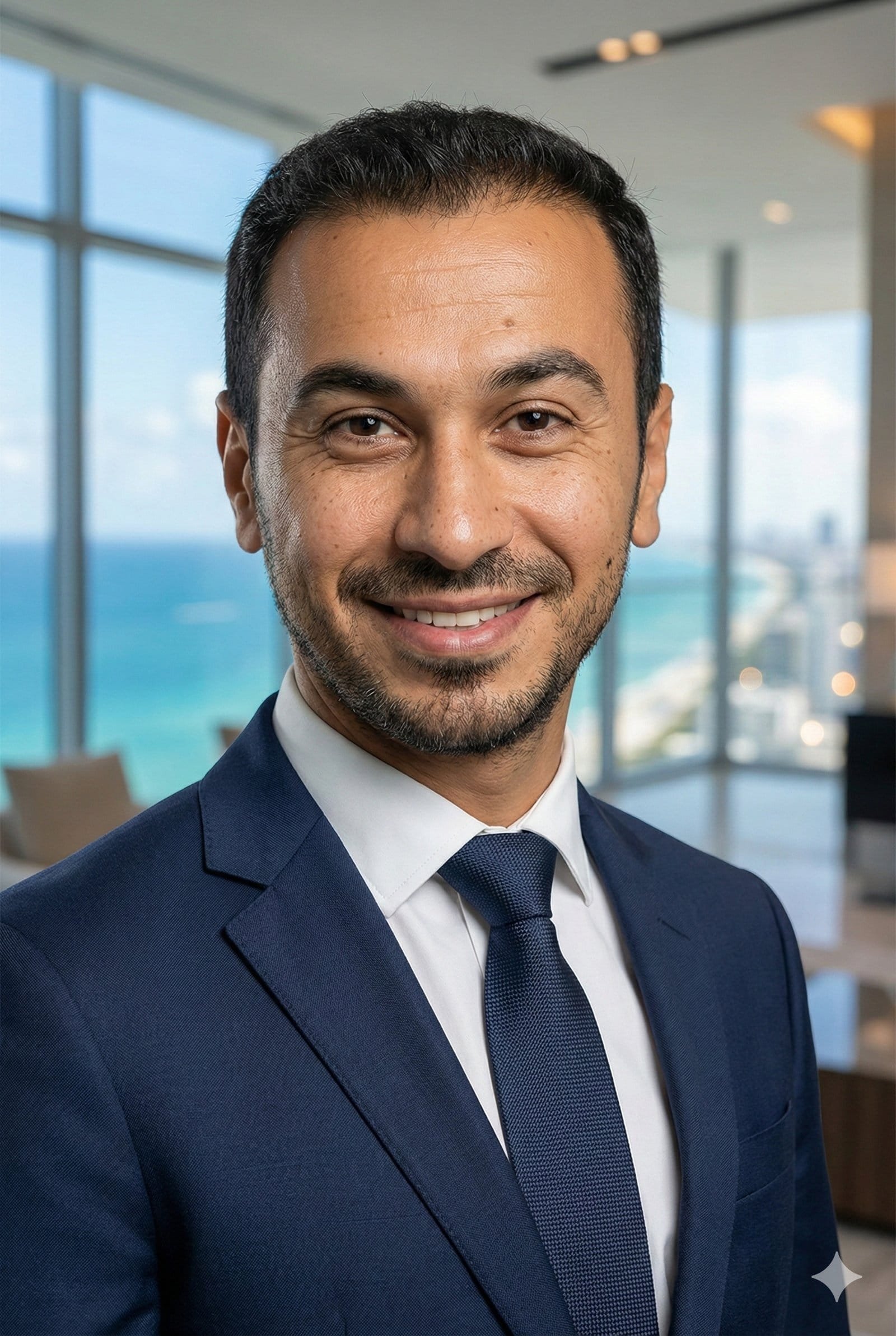
Co-founder of MAMO Property, real estate specialist in Hurghada with 16+ years experience in Egyptian property market.